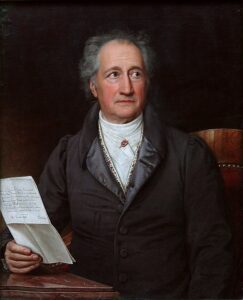
Johann Wolfgang von Goethe

Johann Wolfgang von Goethe[a] (28 August 1749 – 22 March 1832) was a German polymath who is widely regarded as the most influential writer in the German language. His work has had a wide-ranging influence on literary, political, Christian views, and philosophical thought in the Western world from the late 18th century to the present.[3][4] A poet, playwright, novelist, scientist, statesman, theatre-director, and critic,[3] Goethe wrote a wide range of works, including plays, poetry and aesthetic criticism, as well as treatises on botany, anatomy, and colour.

Goethe took up residence in Weimar in 1775 following the success of his first novel, The Sorrows of Young Werther (1774), and joined a thriving intellectual and cultural environment under the patronage of Duchess Anna Amalia that formed the basis of Weimar Classicism. He was ennobled by Karl August, Duke of Saxe-Weimar, in 1782. Goethe was an early participant in the Sturm und Drang literary movement. During his first ten years in Weimar, Goethe became a member of the Duke’s privy council (1776–1785), sat on the war and highway commissions, oversaw the reopening of silver mines in nearby Ilmenau, and implemented a series of administrative reforms at the University of Jena. He also contributed to the planning of Weimar’s botanical park and the rebuilding of its Ducal Palace.[5][b]

Poems

MIGNON

im Jahre 1795

Kennst du das Land, wo die Zitronen blühn, Im dunkeln Laub die Gold-Orangen glühn, Ein sanfter Wind vom blauen Himmel weht, Die Myrte still und…

Read more

An die Mutter

Obgleich kein Gruß, obgleich kein Brief von mir So lang dir kommt, lass keinen Zweifel doch Ins Herz, als wär die Zärtlichkeit des Sohns, Die…

Read more

Der Erlkönig

1782

Wer reitet so spät durch Nacht und Wind?Es ist der Vater mit seinem Kind;Er hat den Knaben wohl in dem Arm,Er faßt ihn sicher, er…

Read more